
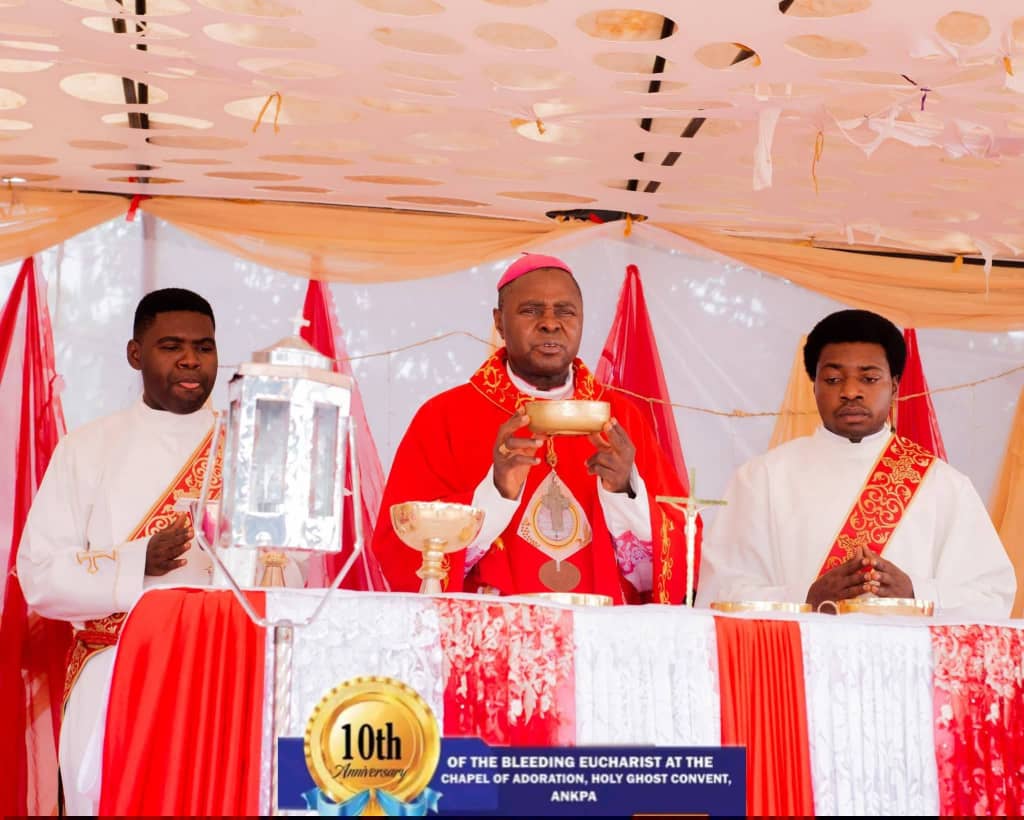
In the quiet town of Ankpa in Kogi State, within the serene walls of the Sacred Heart Chapel of the Sisters of the Holy Ghost Convent, an extraordinary event unfolded in 2016 that would leave an indelible mark on the faithful of the Catholic Diocese of Idah.
What began as a routine
moment of Eucharistic reservation in the tabernacle soon drew attention for a reason both startling and sacred: a consecrated Host was seen to be bleeding. For Catholics, whose faith rests deeply on the mystery of the Eucharist, this occurrence was not merely an event but a profound call to contemplation.
To understand the weight of such an occurrence, one must appreciate how reverent Catholics regard the Eucharist. In Catholic doctrine, at the moment of consecration during Mass, the bread and wine are transformed into the Body and Blood of Jesus Christ—Body, Soul, and Divinity—while retaining the appearance of bread and wine. The body of Christ is the essence of Catholicism. This sacred mystery, known as the Real Presence, stands at the very heart of Catholic worship.
Thus, when a consecrated Host is seen bleeding, it stirs awe, reflection, and renewed devotion among believers who already profess Christ’s living presence in the Eucharist.
The 2016 incident at Sacred Heart Chapel was unusual by every standard.
Pronounced Eucharistic miracles are rare in the Catholic Church and are approached with caution and discernment some taking centuries. Yet, for the local faithful in Ankpa and beyond, the bleeding Host became a visible sign pointing back to a truth they had long professed: that Christ is truly present in every consecrated Host. It was not spectacle that defined the moment, but solemn reverence.
The Bishop of Idah Diocese, Most Rev Anthony Adaji, MSP received the report with pastoral prudence.
Catholic Bishop Condemns Killings in Nigeria, Calls for Urgent Government Action
Recognizing the extraordinary nature of the event, he described it as unusual and worthy of reflection. Rather than rush to sensational conclusions, he chose to guide the faithful toward deeper faith in the Eucharist, emphasizing that the greatest miracle remains the transformation that occurs at every Mass.
In doing so, Bishop Adaji converted what could have been treated as a mere extraordinary occurrence into an enduring expression of faith.
He galvanized his people, priests and lay and reminded them that while the Church is not in a haste to make pronouncements on sensitive issues like that, or for the fact that declaration of recognition usually comes from Rome for any universal status of a miracle, the local Church could still respond with reverence, prayer, and spiritual renewal. Bishop Adaji,’s approach reflected a shepherd intent not on spectacle but on strengthening souls.
From that moment, the 26th of every month became a sacred appointment in Ankpa.
Catholics—and even non-Catholics—gather in convergence for prayer, adoration, and reflection before the Blessed Sacrament. What began as a response to an unusual event gradually evolved into a local pilgrimage of faith, drawing people from different walks of life into deeper communion with Christ.
This monthly gathering is more than a memorial; it is an act of submission to the sacred mystery of the Eucharist. Through prayer, silent adoration, confession, and teaching, the faithful are invited to renew their commitment to Christ truly present in the Host.
Bishop Adaji’s unwavering belief in the power of the Eucharist has shaped this convergence into a powerful spiritual movement within the diocese.
Over the past ten years, this devotion has borne visible fruits. Families testify to renewed faith. Vocations have been strengthened. Those who once struggled with doubt have found clarity and consolation. The bleeding Host of Ankpa became not merely a sign of wonder but a catalyst for authentic conversion.
The miracle of the bleeding Host powerfully underscores what the Church has always taught: Christ is present at every breaking of the bread—Body, Blood, Soul, and Divinity. Whether visibly manifest or hidden under sacramental signs, His presence is constant. The extraordinary event points back to the ordinary miracle reenacted daily on Catholic altars around the world.
For many Catholics, this occurrence deepened their Eucharistic devotion. Faith that was once routine became personal and vibrant. The sacred Host, once received perhaps with familiarity, began to be approached with renewed reverence and gratitude. In this sense, the miracle strengthened Christian faith and reinforced Catholic belief in the Real Presence.
Bishop Adaji’s pastoral leadership over the past decade has been central to this journey. For ten years, he has consistently led priests, religious, and lay faithful in prayer and solid Eucharistic teaching. His homilies and pastoral letters have revolved around the potency of the Eucharist as the source and summit of Christian life, anchoring the diocese in sound doctrine and fervent spirituality.
As Catholics concluded three days of intense prayer from February 26 to February 28, 2026, marking the tenth anniversary of the bleeding Host, the atmosphere was one of gratitude rather than mere commemoration. The faithful gathered not only to recall an event of 2016 but to celebrate a decade of spiritual growth. The real miracle—Christ present at every Mass—was once again reenacted on the altar.
Through these ten years of pastoral stewardship, Bishop Adaji has demonstrated courageous faith. While it belongs to Rome and the Holy Father to pronounce a universal miracle for public acceptance, his recognition of the Ankpa bleeding Host as an extraordinary occurrence reflects a leader who believes deeply in what he knows, practices, and teaches. His response has been marked by prudence, conviction, and devotion.
The Sacred Heart Chapel in Ankpa has thus become a beacon of Eucharistic faith in Kogi State. Pilgrims arrive seeking healing, renewal, and a deeper encounter with Christ. The monthly convergence has grown into a spiritual lifeline, fostering unity, repentance, and transformation among the people of God.
As the Diocese of Idah celebrates this tenth anniversary, the prayer resounds that weakened faith may receive strength and that those with little belief in the mystery of the Body and Blood of Christ may find practical revelation through the event of Ankpa and the journey of the past decade. Ultimately, the bleeding Host directs all hearts to the enduring truth of the Eucharist: that Jesus Christ remains with His people—present, powerful, and profoundly real in every consecrated Host.
JERRY OCHEME IS A JOURNALIST, HE WRITES FROM KANO
