
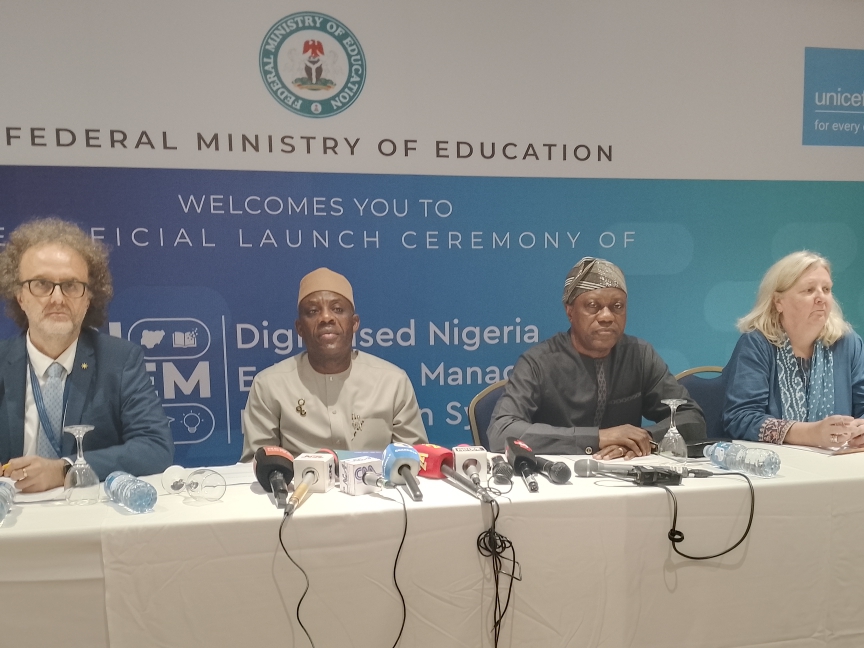
The Federal Government has called on state governments, local government authorities and private school owners to fully participate in the Digitalised Nigeria Education Management Information System (DNEMIS).
Minister of Education, Dr Tunji Alausa who made the call in Abuja on Tuesday during the official launch of DNEMIS, stressed that quality education reforms could only succeed when backed by credible and comprehensive data.
The digital platform provides detailed information on classrooms, teachers, enrolment, computer facilities, water, sanitation and hygiene infrastructure, as well as other indicators needed for effective monitoring and supervision.
Alausa said the digital platform will transform the way education data is collected, analysed and utilised, enabling governments at all levels to monitor schools, identify gaps and deploy resources where they are most needed.
“You have to get the data right. Data allows us to monitor, design interventions, evaluate outcomes and plan proactively for the future. Without accurate data, meaningful development is impossible,” Alausa said.
He commended development partners, including the World Bank, the European Union, the Norwegian Government, UNICEF and other international organisations, for supporting the Federal Government in developing the new education data infrastructure.
Alausa revealed that the implementation of the platform experienced delays before development partners stepped in to accelerate its rollout.
“We were ready to invest whatever it took because without data, we would not know where development is needed. Our partners helped us overcome significant challenges and shortened the implementation timeline considerably,” he said.
The minister also acknowledged the contributions of ICT experts and international collaborators who worked with Nigeria to build an integrated and sustainable education information system.
He said the government would continue strengthening collaboration with development partners to ensure that the platform remains functional, inclusive and beneficial to every level of the education sector.
Addressing private school proprietors, Alausa urged them to upload their data onto the national platform, assuring them that the exercise was not intended for taxation but to improve education planning.
“When you saw the demonstration, almost 90 per cent of public school data had been captured, but private schools were only at about 50 per cent. I want to encourage every private school to register and upload its data.
“Do not worry, the government is not collecting this information to tax you. We recognise the critical role private schools play in Nigeria’s education sector,” he stated.
The minister noted that private schools now account for a significant share of basic education in Nigeria and that their inclusion in the national database is essential for informed decision-making.
“Nearly three-quarters of junior secondary schools are privately owned, and that number continues to grow. We need every school to be part of this system because education planning must reflect the realities on the ground,” he added.
Alausa further said education commissioners, local government education authorities and school administrators would be able to access real-time information to support evidence-based decisions and improve service delivery.
The minister said the platform currently contains data from about 90,000 public schools, with ongoing efforts to ensure complete coverage of both public and private institutions.
He stressed that Nigeria’s education sector serves more than 50 million learners, making accurate and timely data indispensable for national planning.
“We are building a system that will support policy decisions, improve accountability and strengthen education delivery across the country. Every stakeholder has a responsibility to ensure the information is complete and accurate,” he said.
Alausa also called on state governments to intensify awareness campaigns and mobilise schools within their jurisdictions to participate in the exercise, while pledging continuous engagement with stakeholders to improve data quality and expand the system’s coverage.
Also speaking, the Director-General of the National Bureau of Statistics (NBS), Semiu Adeyemi Adeniran, pledged the agency’s full support for DNEMIS, saying it the country’s single, reliable source of education data.
Adeniran said NBS would integrate its data systems with the education database to improve planning, policy implementation and monitoring across the sector.
“We just want one true source of data for education, and we are going to link the NBS platform with the ministry’s system so we can produce and disseminate reliable education statistics with wider national coverage,” he said.
He also disclosed that NBS would support the platform by mapping out-of-school children through household surveys and using its Small Area Estimation data to validate information generated by the education database.
According to him, “The data that comes from our Small Area Estimation will help validate and cross-check what is on the education platform.”
