
By Stephen Adeleye
Lokoja, Sept 16, 2026
The United Nations Development Programme (UNDP) funded Global Environment Facility Small Grants Programme (GEF-SGP), Nigeria, implemented by the Climate and Sustainable Development Network (CSDevNet), has empowered coal mining communities in Enjema District of Ankpa Local Government Area of Kogi State with climate resilience tools to restore degraded lands and improve livelihoods.
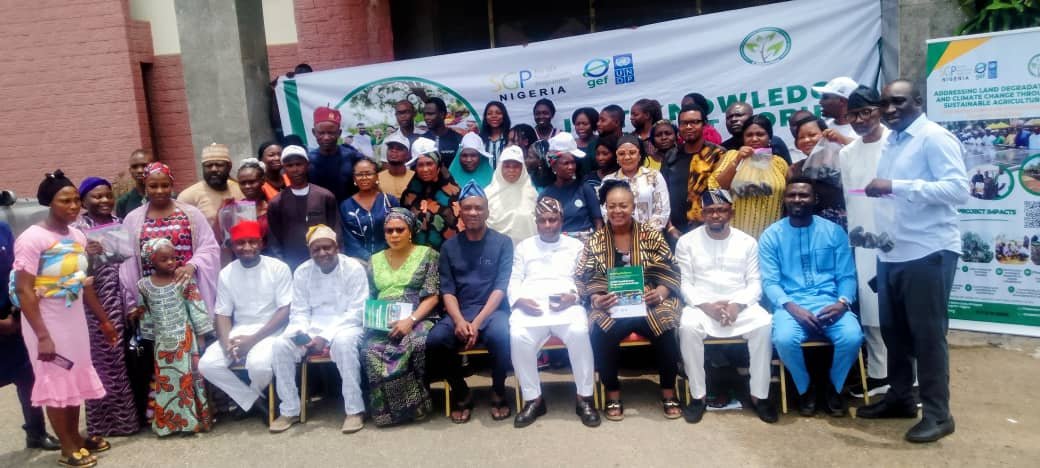
The empowerment was highlighted on Wednesday in Lokoja at the Project Knowledge Management Forum and official close-out event for the project titled: “Addressing Land Degradation and Climate Change through Sustainable Agriculture in Coal Mining Communities in Enjema District, Ankpa LGA, Kogi State.”
The forum, which also featured a high-level policy dialogue, brought together government officials, development partners, traditional institutions, civil society organisations and community beneficiaries to reflect on lessons learned and chart sustainability plans.
In his welcome address, the National Network Coordinator of CSDevNet, Mr. Steve Abuh, said the gathering was not just to formally close the project, but more importantly to reflect on what the experience in Enjema has shown about community-led environmental action, sustainable livelihoods and local ownership.
Abuh disclosed that the project commenced in October 2025 and ended in May 2026.
He noted that within the implementation period, the project demonstrated that investments in climate-smart agriculture, renewable energy, sustainable aquaculture and community institutions can simultaneously restore degraded landscapes and strengthen rural livelihoods.
According to him, the establishment of demonstration farms, Village Savings and Loan Associations (VSLAs), solar-powered water system and the Community Green Action Plan (CoGAP) provides a foundation that the community can build upon long after project funding has ended.
“The work carried out in Enjema demonstrates that environmental challenges are best addressed when communities are not simply beneficiaries, but active partners in identifying problems, implementing solutions and shaping their own priorities.
“The development of the Community Green Action Plan (CoGAP) is particularly significant as it provides a platform for sustaining community priorities and strengthening environmental governance,” Abu said.
He expressed delight that the forum brought together government, development partners, traditional institutions, civil society and community actors.
He stressed that sustainability and scaling of successful community initiatives depend on stronger linkages between local experience and public policy.
Abu urged stakeholders to use the forum not only to celebrate achievements but to examine what can be sustained, strengthened and what lessons from Enjema can inform environmental action across Kogi State and beyond, while appreciating GEF-SGP, UNDP, partners and the Enjema communities.
In her remarks, the National Coordinator of UNDP GEF-SGP Nigeria, Dr Ibironke Favour Olubamise, said the programme was established on the belief that lasting environmental solutions are achieved when communities are empowered to lead the process.
Olubamise noted that the experience in Enjema District was a compelling demonstration of this principle in action.
She stressed that the CoGAP provides a practical framework for sustaining environmental action and offers a model that can inform similar initiatives in other mining-affected communities across Nigeria.
She commended CSDevNet, the Kogi State Government, Ankpa LGA, traditional institutions, community members and all partners for their dedication and collaboration, and urged beneficiaries to take ownership of the project outcomes.
On his part, the Kogi State Commissioner for Environment and Ecological Management, Engr. Olusegun Joseph, who represented Gov. Ahmed Ododo, commended CSDevNet, UNDP and other partners for the successful implementation of the project.
Joseph enumerated key achievements of the state government in flood mitigation, climate change resilience, erosion control as well as measures put in place to regulate mining activities for the benefit of the people.
Also speaking, the Chairman of Ankpa Local Government Area, Hon. Ademu Yahaya, commended the partners for the initiative and for choosing Enjema community for implementation.
Other stakeholders at the event included the Executive Secretary of the State Emergency Management Agency (SEMA), Mr. Muktar Atima; representatives of the Ministries of Agriculture and Health; Director-General of the Kogi Climate Change Agency; NGOs, traditional and community leaders and beneficiaries from Enjema District.
Some beneficiaries, including Mr. Yakubu Sule, Mr. Umar Othman, Hajia Habibat Yusuf and Mr. Abubakar Yahaya, commended CSDevNet and UNDP GEF-SGP for impacting their lives and giving them hope.
Speaking on behalf of the community, Othman said life had been difficult due to pollution from coal mining activities which contaminated rivers and destroyed farmlands, forcing residents to travel long distances to farm on other people’s land.
He said community members had cried out to several organisations without response until God answered their prayers through CSDevNet.
“For the first time in the history of Enjema community, we never knew that fish can be reared in the house. We were told that if you want to eat fish, you have to take your net or hook to the river, but those rivers are no longer there because pollution from coal mining has contaminated them,” he said.
He explained that components such as fish farming, maize production, sack farming and palm tree planting have had multiplier effects on the community, with children now seeing fish farming as a viable occupation.
According to him, the introduction of sack farming has reduced the burden of travelling far in search of fertile land, as residents can now transport fertile soil to their backyards to plant yam and other crops, while awareness on palm tree planting has generated interest among residents.
Othman appealed to the state government to enforce reclamation of mined lands by mining companies to make them useful for farming again, and thanked CSDevNet, GEF-SGP, UNDP and the Kogi State Government for allowing the project to be implemented.
“This government is a people-oriented government for allowing them to come and give us this programme.
“We say thank you to all stakeholders for giving us this opportunity,” he said.
