
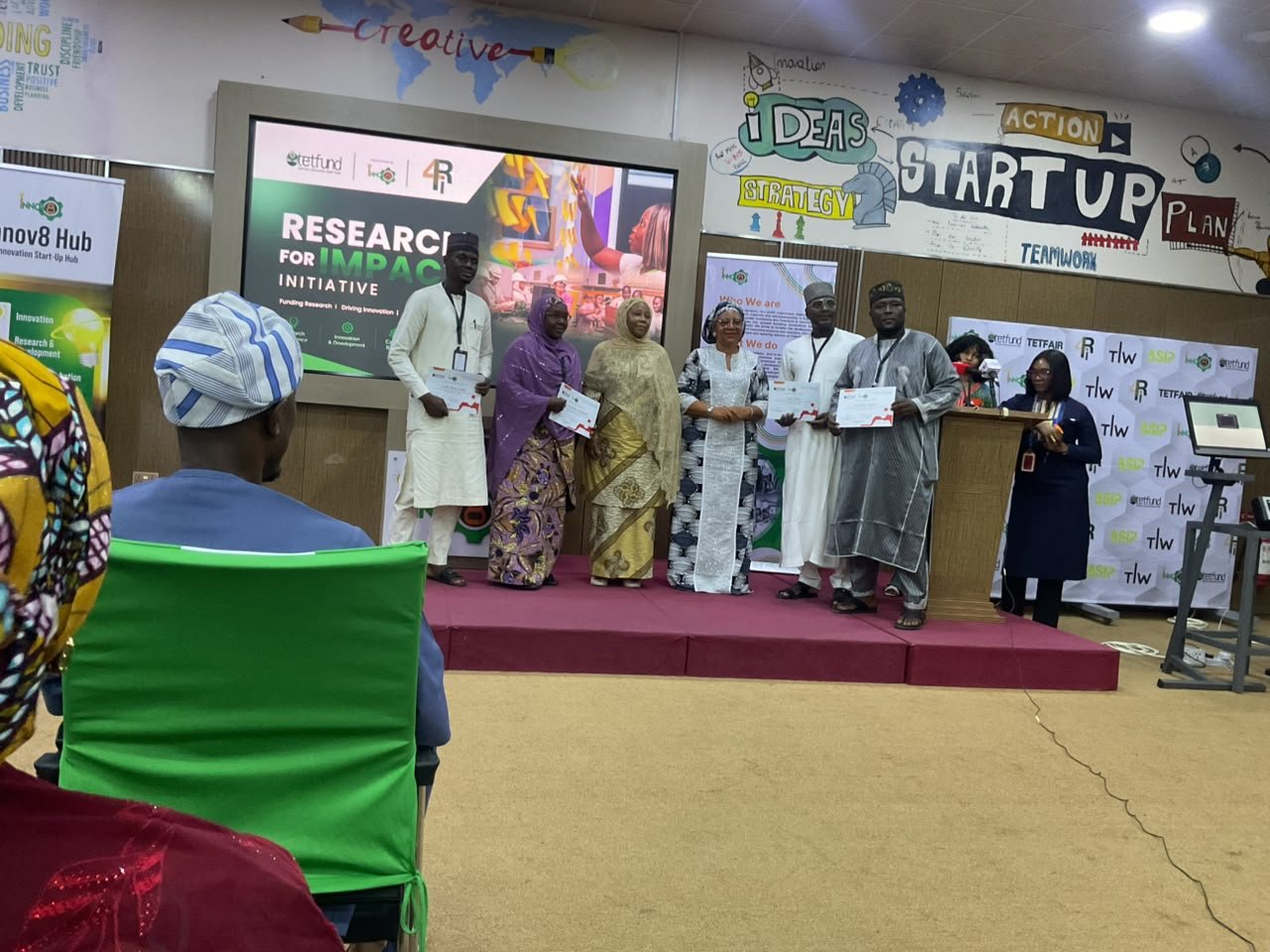
The Tertiary Education Trust Fund, TETfund has urged Nigerian academics and researchers to move beyond publishing scholarly papers to developing practical innovations that address societal challenges and create economic opportunities.
The Executive Secretary of TETFund, Dr Sonny Echono, made the call in Abuja, through the Assistant Director, Research and Development, Dr Hadiza Ismail, at the closing ceremony of the 35th cohort of the Research for Impact Initiative, R4i.
Echono said the initiative, implemented in partnership with Innov8 Hub, was part of the Fund’s strategy to institutionalise research and development in public tertiary institutions and strengthen the relationship between academic research, industry and government.
READ Echono Calls On Nigerians To Emulate Oloyede’s Legacy Of Integrity, Service
He said, “We must empower our scholars to create local solutions for our societal problems. This is why a commitment to education is a commitment to our nation’s future, ensuring that our people are not just consumers of foreign technology, but innovators who can drive sustainable growth.”
The executive secretary said Nigeria needed to strengthen its capacity to develop home-grown technologies rather than depend continuously on innovations from other countries.
He noted that technological advancement had become a major driver of economic transformation, adding that countries seeking sustainable development must invest in quality education, research and innovation.
“At TETFund, we are refocusing and reinvigorating our intervention activities to drive the institutionalisation of Research and Development in public tertiary institutions, enhance research capacity, and support research-industry linkage, among others,” he said.
According to him, the Research for Impact Initiative is designed to reposition public tertiary institutions as drivers of a knowledge-based economy through innovative practices and solution-driven research.
Echono commended Innov8 Hub for providing technical expertise and mentorship to participating academics, urging the graduates to apply the knowledge acquired during the intensive training to develop solutions for their institutions and communities.
He also disclosed that some innovations emerging from previous editions of the programme were showcased at the maiden TETFund National Research Fair and Exhibition in November 2024.
He said the second edition of the fair would hold from November 23 to 27, 2026, at the Abuja Trade and Convention Centre, Airport Road, providing opportunities for researchers to showcase their innovations, connect with industry players and explore partnerships for commercialising research outputs.
The Deputy General Manager of Innov8 Hub, Dr Deji Ige, said the initiative was designed to establish a culture in which research and development drive innovation, enterprise creation and national development.
Ige said the programme was helping academics rethink the purpose of research by encouraging them to develop practical solutions with potential benefits for industry and society.
“Innovation thrives in a culture where research and development are the primary languages of interaction. If we can learn, understand and revive this culture, the outcomes will include inventions, solutions, technological advancement, enterprise development, job creation, wealth generation, meaningful impact and societal development,” he said.
He described the programme as a shift towards stronger collaboration among government, academia, industry and society, adding that research without practical impact could limit the ability of tertiary institutions to contribute to technological advancement.
“Impact-driven research and development is what keeps it afloat and enables it to navigate safely. Without impact flowing from research and development, academia becomes an immobile vessel, bereft of progress, possibilities and the power to navigate,” Ige said.
He added that the collaboration between TETFund and Innov8 Hub was helping to strengthen the connection between academic knowledge and practical innovation.
One of the participants, Farida Adamu Mohammed of the Federal Polytechnic, Damaturu, said the programme had changed her understanding of research by shifting her focus from academic publications to solutions that could be commercialised.
Mohammed said the 10-day intensive training equipped her with skills in identifying real-world problems, selecting viable ideas, understanding users’ needs and developing prototypes.
She said the training also exposed participants to the responsible use of artificial intelligence, the Business Model Canvas, user co-creation and effective communication for pitching ideas to potential funders and collaborators.
“Indeed, R4i has completely changed my perspective on research, shifting my focus from research for publication to research that creates impact, drives commercialisation, and generates profit,” she said.Mohammed added that the lessons would help her develop research outputs that deliver practical value and have greater prospects for commercialisation.
Similarly, Engr. Austine Omoraka of the Federal Polytechnic, Orogun, Delta State, said the programme had strengthened his commitment to applying engineering research to practical challenges in Nigeria, particularly in his state.Omoraka said the combination of research, prototyping, market validation and business planning had given him a more structured approach to developing ideas into potentially marketable solutions.
“The training has encouraged me to view research not merely as an academic exercise but as a pathway to innovation and societal transformation,” he said.He added that applying the knowledge gained could contribute to the development of affordable local technologies, entrepreneurship, employment opportunities and sustainable economic growth.”
The members of cohort 35 were divided into six teams.
Team one unveiled “Bake check, a web-based application that screens bread for bromate by analysing colour changes in a test solution using image capture and calibration.
Team two developed EcoCeramix, a bio-absorbent clay geo filter cartridge made from locally calclined clay, silica and rice husk ash designed to fit standard household water-storage buckets.
Other innovations unveiled include a hardware based device designed to scan piles of waste at dump sites and recycling facilities names Ecosort, a cooperative-operated storage facility tagged Agrivault, a real time delivery tracking application and a solar-powered mosquito-responsive device.
The Research for Impact Initiative is a collaborative programme established by TETFund and Innov8 Hub to help academics and researchers translate research ideas into practical innovations, prototypes and potentially commercial products. The initiative was launched in 2022 to address the gap between academic research and its application to real-world problems.
According to programme information published by Innov8 Hub, participants undergo intensive, hands-on training in problem identification, empathy research, ideation, testing, prototyping, pitching, business planning, fundraising and business incubation. The process is intended to help researchers assess the needs of potential users and develop solutions with prospects for adoption and commercialisation.
The initiative also promotes the triple helix model, which encourages collaboration among government, academia and industry.
Ige’s remarks highlighted a broader quadruple helix approach that includes society as a fourth stakeholder in the innovation process.
The programme’s outcomes have included innovations addressing challenges in agriculture, healthcare, environmental sustainability, energy and infrastructure. Examples previously showcased by Innov8 include technologies for extending the shelf life of fruits and vegetables, supporting older people and improving water management.
TETFund has also reported that 18 researchers trained through R4i secured a collective $250,000 grant under the Science Granting Councils Initiative in 2024 to advance four innovations towards commercial viability. The development illustrated how research training could create pathways to further funding and product development beyond the initial programme.
The initiative complements TETFund’s broader research and development interventions, including the TETFund Alliance for Innovative Research, which supports the advancement of research outputs and the development of prototypes with commercial potential.
However, the long-term value of such initiatives depends not only on the number of researchers trained or prototypes developed, but also on whether the resulting innovations attract further investment, reach intended users and become sustainable solutions.
Echono urged the graduates of Cohort 35 to build on the experience gained during the programme, while reaffirming TETFund’s commitment to supporting the initiative as part of efforts to strengthen Nigeria’s research ecosystem and promote sustainable national development.
