

A Professor of Public Administration at Federal University Lokoja, Professor Inyokwe Sunday Otinche, has warned that Nigeria faces serious risks from rising insecurity, poverty, unemployment, illiteracy and growing social divisions, arguing that the country’s nation building project remains under pressure from challenges that continue to threaten national cohesion.
Salman Idris Reaffirms Commitment to Military Forward Base After Iluke Tragedy
Professor Otinche made the assertion on Wednesday, while delivering the 42nd Inaugural Lecture of the Federal University Lokoja titled, The Looking Glass Self Perspective of How Never to Build a Nation in the New World Order: Reflections on Nation Building Experiments in Nigeria.
In the lecture, the scholar examined Nigeria’s nation-building journey through the lens of governance, democracy, power sharing, religion, national security and leadership, drawing attention to factors he believes have hindered the country’s progress since independence.
He argued that national security extends beyond armed conflict and includes issues such as ignorance, illiteracy, unemployment, food insecurity, corruption, political intolerance and religious intolerance.
According to him, terrorism, banditry, kidnapping, insurgency and other forms of violent criminality have continued to undermine development efforts while exposing citizens to hardship and uncertainty.
Professor Otinche observed that the humanitarian consequences of insecurity have become increasingly evident in the displacement of citizens, loss of lives and destruction of property across different parts of the country.
He further warned that prolonged terrorism and banditry, particularly in Northern Nigeria, could negatively affect regional development and widen existing divisions within the country.
The professor identified poverty, unemployment and illiteracy as factors that increase the vulnerability of young people to recruitment by terrorist and criminal groups, stressing the need for education and capacity building as pathways to sustainable development and national security.
He also linked some of Nigeria’s security challenges to unresolved questions surrounding power sharing, national integration, ethnicity and religion, maintaining that these issues remain important to understanding contemporary governance challenges in the country.
Professor Otinche concluded that the rising level of insecurity in Nigeria and other parts of the world points to a gradual erosion of humanity and collective values, urging Nigerians to strengthen national consciousness and work towards preserving unity.
Earlier in his address, the Vice Chancellor of Federal University Lokoja, Professor Gbenga Solomon Ibileye, described the lecture as an intellectually engaging exploration of nation building and the Nigerian experience.
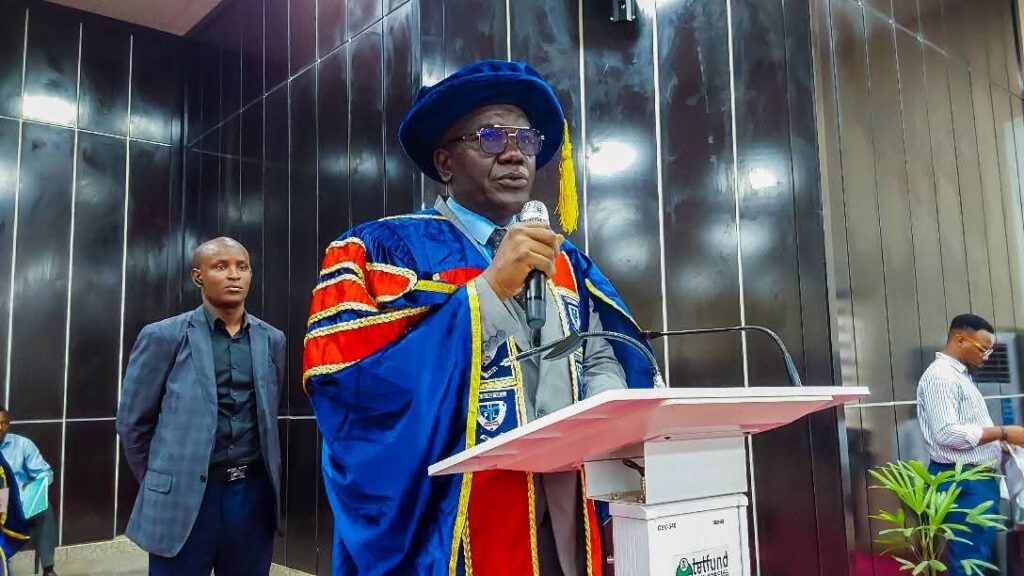
Professor Ibileye noted that the lecturer had drawn on Charles Horton Cooley’s Looking Glass Self theory and applied it in an interdisciplinary manner to interrogate the Nigerian state and its development trajectory.
The Vice Chancellor observed that while the concept originated in sociology and later found relevance in social psychology, linguistics, communication and cultural studies, Professor Otinche had successfully deployed it as an analytical framework for public administration and nation building.
He described the lecture’s title as both striking and courageous, noting that the approach challenged society to reflect honestly on its experiences and confront difficult realities.
