
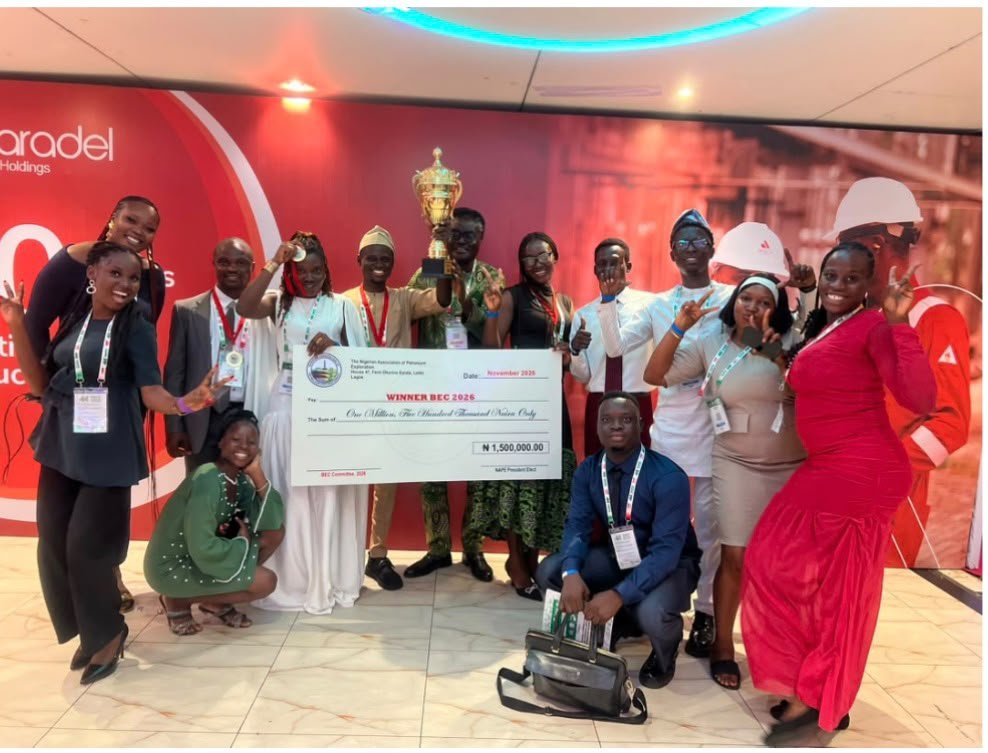
Ekiti State University (EKSU), Ado-Ekiti, has announced its arrival on Nigeria’s academic stage in spectacular fashion, emerging overall champion of the Nigerian Association of Petroleum Explorationists (NAPE) Basin Evaluation Competition and defeating several established institutions, including the University of Lagos and the University of Ibadan, in its maiden appearance.
For a university making its debut at a competition of this standing, the achievement is particularly significant. But beyond the excitement of lifting the trophy and the prestige of finishing ahead of more established institutions, EKSU’s triumph offers a glimpse into a much bigger ambition, one that seeks to position its Department of Geology as the best in Africa within the next five years.
This is the vision articulated by the University’s Chancellor, Dr Tunji Olowolafe, whose aspiration for the department is gradually finding expression through deliberate investments in infrastructure, research facilities, technology and human capital development. The emerging transformation suggests that the ambition is being pursued with a clear understanding that academic excellence cannot be achieved through declarations alone. It requires the right environment, appropriate resources and sustained institutional commitment.
In this regard, the interventions of the Tunji Olowolafe Foundation have been particularly instrumental in strengthening the department’s operational and academic capacity. The Foundation has provided a brand-new 11-seater bus, five high-performance computers with monitors and a large-format colour poster printer for the departmental workstation. Other provisions include a fifth-generation HP laptop, colour printing and photocopying equipment for the Head of Department’s office, a 6.2KVA inverter with solar panels, a 55-inch Hisense smart television, a projector for postgraduate classes and Starlink internet connectivity, among other facilities.
These provisions go beyond routine institutional support. In a field such as geology, where research increasingly depends on digital resources, technical applications, data interpretation and access to current scientific information, a properly equipped workstation and reliable internet connectivity are essential tools for meaningful academic advancement.
The investment in human capital is equally noteworthy. In 2025, the Foundation sponsored six students and two lecturers to the NAPE Mini Conference at Kwara State University, where EKSU finished fourth. Building on that experience, eight students and a lecturer were subsequently supported to attend the 44th NAPE Conference at Eko Hotel, Lagos. The Head of Department, Professor Adeyinka Aturamu, also benefited from the Foundation’s sponsorship to participate in a leadership programme at the National Institute for Policy and Strategic Studies, Abuja.
Viewed against this background, EKSU’s latest triumph is more than an impressive competition result. It reflects the gradual development of a department that is increasingly exposing its students and lecturers to professional standards, competitive academic environments and the practical demands of the geosciences industry.
The victory, delivered by students Lawrence Blessing Ayomide, Makanjuola Peteru Ayomide and Adeniyi Favour Olaoluwa, is a testament to the talent, preparation and determination within the department. It also demonstrates the possibilities that emerge when individual competence is reinforced by institutional support and access to the right learning resources.
Reacting to the achievement, the Vice-Chancellor, Professor Joseph Babatola Ayodele, congratulated the Head of Department, Professor Adeyinka Aturamu, and the victorious team, particularly Makanjuola Peteru Ayomide and Adeniyi Favour, for bringing honour and recognition to the University. He expressed admiration for the students’ outstanding performance, especially considering that EKSU was participating in the competition for the first time.
Professor Ayodele was equally full of admiration for the Chancellor, Dr Tunji Olowolafe, and the Tunji Olowolafe Foundation for their sustained commitment to the development of the Department of Geology. His commendation reinforces the importance of purposeful collaboration between the University’s management and its development partners in creating the conditions necessary for academic distinction.
For Professor Aturamu, the achievement also provides an opportunity to acknowledge the impact of the support received by the department. He expressed gratitude to the Chancellor and the Tunji Olowolafe Foundation for upgrading the departmental workstation and providing internet facilities, noting that these interventions have strengthened the department’s research capabilities and enhanced its capacity to undertake more productive academic work.
His remarks underscore an important point: the value of investment in education is ultimately measured not merely by the facilities provided but by the improvements they bring to teaching, research, learning and the quality of graduates produced.
For EKSU, therefore, the NAPE victory should be seen as both an achievement and a responsibility. It has demonstrated that its Department of Geology can compete successfully with some of the country’s leading institutions. The next challenge is to sustain that performance, deepen its research culture, build stronger relationships with industry and expand opportunities for students to engage with emerging developments in petroleum exploration and the wider geosciences.
The ambition to become Africa’s best Department of Geology within five years is undoubtedly a demanding one. Continental leadership requires more than isolated competition victories. It demands consistent research output, internationally competitive academic programmes, strong industry partnerships, modern laboratories, global collaborations and a steady pipeline of highly skilled graduates.
Nevertheless, EKSU appears to have identified the right starting point: invest in people, strengthen infrastructure, encourage exposure and create an environment where talent can flourish.
With the institutional leadership of Professor Joseph Babatola Ayodele, the strategic vision of Dr Tunji Olowolafe and the continued support of the Foundation, the Department of Geology has an opportunity to translate its current momentum into lasting academic distinction.
The NAPE trophy may be the immediate reward, but its greater significance lies in the possibilities it has opened. EKSU has made a statement on the national stage. The bigger task now is to turn that statement into a sustained presence on the African academic landscape.
For a department with such an ambition, this may well be only the beginning.
