
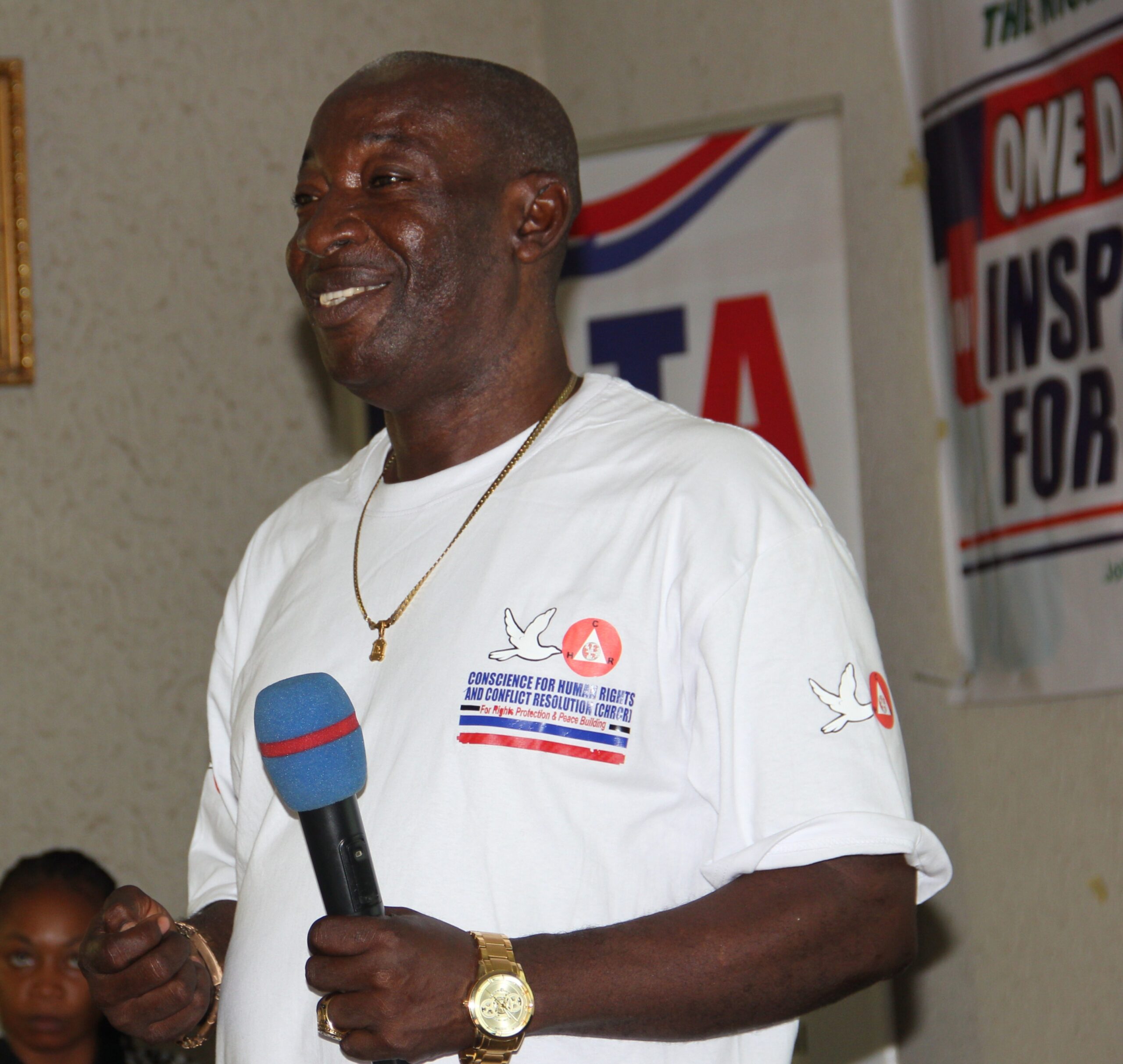
By IDRIS MILIKI ABDUL,
Executive Director,
Conscience for Human Rights and Conflict Resolution (CHRCR),
Lokoja, Kogi State.
*AT*
*PRE-2026 INTERNATIONAL MAY DAY CEREMONY*
*BY KOGI STATE COUNCIL OF ORGANIZED LABOUR*
On 30th April, 2026
*SECURITY AND WELFARE OF THE PEOPLE*
In Nigeria, we proudly proclaim civil and political liberties—life, dignity, liberty, expression, assembly, and fair hearing. Yet, for millions, these rights function as formal guarantees without material access. You can have the right to vote and still be excluded by poverty; you can have freedom of expression and still be silenced by illiteracy; you can have the right to life and still be denied lifesaving healthcare because you cannot pay.
In practice, non-justiciable socio-economic rights create a two-tier constitution: civil and political rights that the well-off can meaningfully enjoy, and a catalogue of socio-economic promises that the poor cannot enforce. The result is a predictable spiral: inequality, exclusion, grievance, and instability. That spiral is a security problem.
Section 14(2)(b) of the Constitution provides that the security and welfare of the people shall be the primary purpose of government. By virtue of section 217 thereof, the armed forces shall defend the territorial integrity of the nation. It is the Nigeria Police Force that is responsible for the maintenance of law and order as prescribed by Section 215 thereof. However, the armed forces may be involved in internal security to the extent of aiding the civil authority to restore law and order.
The recent development in Kogi State that motivated, the closure of all Primary and Secondaries Schools temporarily and the close of some markets and motor packs across the Local Government in the western district, is a proactive measured due to security challenges according to the government statements through the commissioner for Information, is a welcome development and commendable. More worrisome is the invasion and adoption of children and some of their staff at the Zango-Daji Orphanage home, which is condemnable. However, the security personnels and their agencies, which include the Nigeria Police Force (NPF), the Military and all the Paramilitary are Federal staff that are currently involve in the onslaught in the security effort across the State, that are not permanent residence in a particular location for a long time and can be redeployed any time for special duties or otherwise. And many of them does not speak the local languages. Therefore, the need for the State Government to employ at least twenty (20) Vigilantes in each ward of Kogi State, to complement the work of these conventional security personnel and their agencies, that will be trained and equipped to stay in their various ward or locality. Community Resilience, engagement and support can do a lot the current violence extremism that is currently being experienced in our environment.
Violent Extremism in Nigeria is often fueled by political and economic factors such as governance failure, corruption, inequality, and lack of opportunities, all of which create conditions conducive to radicalization perceive political exclusion, unemployment, and poverty make individuals vulnerable to extremist narratives that exploit social and economic grievance. Additionally, weak institution and poor service delivery enable extremism to thrive.
Nigeria’s response to violent extremism remains fragmented and uneven. These interventions, while valuable in their own right, often operate in silos, lacking the strategic coordination, shared data system and unified policy directions necessary for sustained impact.
One of the most persistent challenges undermining the effectiveness of Nigeria response to Violent Extremism is the lack of strategic coordination among Federal, State, and local actors. While each level of government plays a critical role in security and peacebuilding, there are often disconnected, duplicative, or misaligned, resulting in fragmented intervention and missed opportunities for synergy. Nigeria has witness a growth in number of both statutory and non –statutory security agencies across all level of government.
*National integration of PCVE Strategies:* To effectively counter the evolving threat of violent extremism across Nigeria, it is imperative to align the efforts of the federal, state and local governments under a unified, coherent framework that promotes consistency, accountability, and shared objectives. Fragmented interventions where each tier of government operates in isolation have led to duplication of effort, policy contradictions, and inefficient resources utilization. A harmonized approach ensure that all actors are working toward a common vision, with clearly defined roles and measurable outcomes.
*REFLECTIONS ON POVERTY ERADICATION IN NIGERIA*
Poverty in Nigeria is deep, widespread and multifaceted, and Nigerians are all victims of this condition in one way or the other – the rich elite and the poverty-stricken masses alike – although not to the same degree. A cursory look at the available statistics paints a very gloomy picture of the nature and dynamics of poverty in Nigeria.
Poverty is about people – ordinary Nigerians standing at the thresholds of death and despair. In our view, poverty is, at its root, bred by unequal power relations, the structural and systematic allocation of resources among different groups in society, and the differential access to power and the political process. The distorted distribution of the nation’s wealth has resulted in the enrichment of a minority at the expense of an impoverished majority. There is no doubt that the chronic nature of poverty in Nigeria has a link to historical and continuing mismanagement of resources and corruption. In short, poor governance has had a huge role to play in guaranteeing this parlous state of affairs.
The implication of the above is that any attempt to take poverty reduction or eradication from the ambit of rhetoric to action must recognise the need to locate it within the framework of governance, by bringing politics back into policy-making. As Nigeria is carrying forward its strategy for poverty reduction, the media is one critical player in ensuring that all Nigerians – in their various communities and constituencies – have a role to play in promoting a clearer understanding of the poverty situation.
Across Nigeria, the priority areas for the poor also relate to how best to reduce the shocks that might upset their security: the lack of potable water; inadequate access to education and health; the lack of rural feeder roads; the unavailability of markets for locally made goods; the lack of processing facilities; and the lack of agricultural inputs, all of which are on the list of top priorities of the poor.
This is where there is a most crucial role for the media. As the most articulate vehicle for addressing the peoples’ yearnings to their leaders, the media can be seen as providing the necessary bridge in communicating the peoples’ views on poverty and linking up with civil society institutions on bringing these issues to the public domain.
Ultimately, democratic and good governance is pivotal to poverty eradication in Nigeria. Without doubt, the capacity of governments to govern can make a crucial difference both to the trajectory of poverty and to its impact on equitable resource distribution. There is ample evidence in literature to demonstrate that where governments have ceased to exist, acute physical insecurity for ordinary individuals and communities is exacerbated, and this leads to the loss of basic services like health and education, the destruction of physical and social capital, and the production of widespread poverty and immiseration.
There is need to reiterate the view that Nigeria is at a crucial juncture in the effort to move from a transitional phase of civilian rule to a consolidated phase of democracy. The extent to which the poverty levels in the country is reduced has a direct correlation to sustainable democracy in Nigeria, and the failure to do so, by implication, is also directly correlated to the poverty eradication campaign. In fact, it is in the interest of the elite stratum in society (media and civil society, all) to ensure that poverty is wiped out in society and on the face of the earth. This is not utopian thinking and the first step to take to ensuring that this happens is the empowerment of the people to take control of their lives. Raising awareness through every medium – radio, television, newspapers, community mediums, social media platforms, etc represents a major way in doing this. But in order to empower the people, the media must also be empowered with the appropriate and accurate information on the nature of the problems and the various solutions possible. Until power is moved from the centre to local communities and constituencies, it would be difficult to tackle the root causes of poverty. The thrust, therefore, is to work with local communities in defining and articulating a nuanced understanding of poverty and the adequate responses to it.
This said, while being committed to participating in this process there is also the necessity of underscoring the importance of producing alternative frameworks that can help government sharpen its own findings, whilst working in synergy with the civil society and other critical stakeholders like the Organized Labour. Based on the above comments, one needs to take the following lessons to mind:
*RECOMMENDATIONS*
– There is need for conceptual clarity through a comprehensive approach to any anti-poverty strategy in policy and development circles, and the media must help to promote this;
– Ultimate poverty eradication is only possible in the context of local empowerment and fiscal decentralization;
– The poverty reduction strategy adopted must recognize the need to reconcile economic and social development and enhance the input of non-state actors in policy formulation, in order to enhance social capital rather than entrench the leverage of donor agencies on states;
– The poverty reduction strategy adopted must problematize the link between globalization and poverty reduction, rather than assume that it is always going to be positive in the promotion of pro-poor growth;
– The poverty reduction strategy must locate the poverty agenda within the democracy and development framework by bringing back accountable politics into policy making; and
– An empowerment approach to poverty reduction is a process, whose results will not necessarily be immediate; hence the need for a long-term view by interested stakeholders and anti-poverty strategists.
*CONCLUSION*
The Nigerian Constitution does not give us the luxury of choosing between rights and security. It commands us to pursue both. Security without welfare is brittle; welfare without security is fragile. The duty of our generation, in civil society, Organized Labour and Government, is to insist that rights are not paper promises but living guarantees. That is how the Republic can be stabilized, and that is the only way we make citizenship meaningful for every Nigerian.
IDRIS MILIKI ABDUL is Executive Director, Conscience for Human Rights and Conflict Resolution (CHRCR).
