
By Janet Samuel | DAKAR, Senegal
West Africa sits atop enormous energy wealth yet millions of its people remain in the dark. The Economic Community of West African States (ECOWAS) is now moving to close that gap with a sweeping regional strategy aimed at converting the bloc’s natural resources into reliable, sustainable electricity for all.
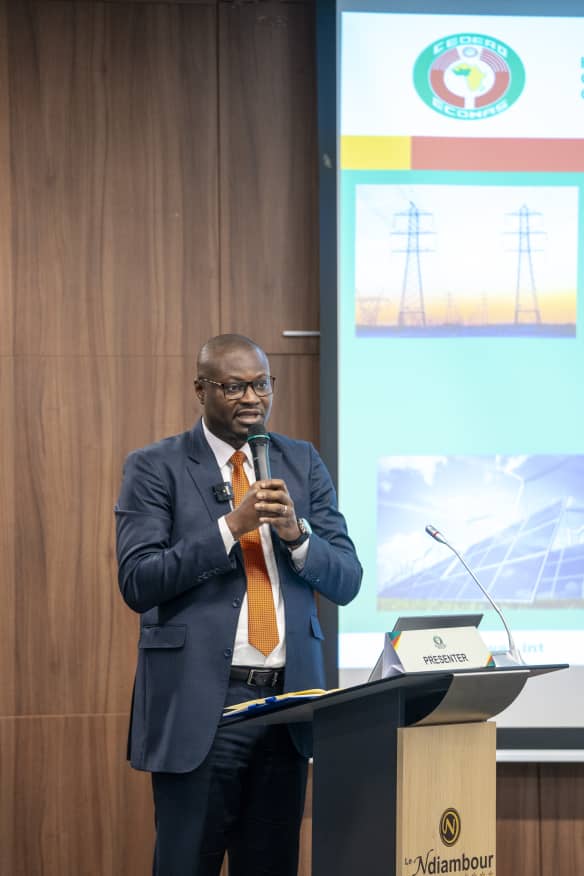
The issue took center stage at a presentation delivered by Mr. Koumoin Arbaduis, Acting Head of Conventional Energy at the ECOWAS Directorate of Energy and Mines, during an ongoing delocalized joint meeting of ECOWAS Parliament committees covering Energy and Mines; Infrastructure; and Agriculture, Environment and Natural Resources, currently underway in Dakar, Senegal.
READ FTAN Woos GIZ–ECOWAS for African Continental Free Trade
Speaking on “ECOWAS Regional Energy Policies and Key Energy Statistics,” Arbaduis painted a stark picture: a region endowed with oil, natural gas, biomass, uranium, mineral coal, and an estimated 25,000 megawatts of hydroelectric potential — yet plagued by chronic power shortages, low electricity access, heavy reliance on petroleum, and expensive, inefficient transmission networks.
Decades of Policy, One Persistent Problem
The ECOWAS response has been decades in the making. Arbaduis traced the region’s policy journey back to 1982, when the first ECOWAS Energy Policy was adopted in the wake of the global oil crises of the 1970s, establishing a foundation for regional energy cooperation and grid integration.
The 2003 ECOWAS Energy Protocol followed, providing a legal backbone for long-term cross-border investment, trade, and the creation of the West African Power Pool.
Three years later, the 2006 ECOWAS/UEMOA White Paper turned attention to rural and peri-urban communities, targeting electricity access for populations historically left behind.
By 2013, the bloc had adopted both a Renewable Energy Policy and an Energy Efficiency Policy, designed to clean up the regional electricity mix and reduce costly technical and commercial losses. In 2017, a Bioenergy Policy and a Gender Mainstreaming in Energy Access Policy broadened the agenda — recognizing that sustainable energy development must be both environmentally sound and socially inclusive.
A 2023 Reset — and a Hydrogen Bet
More recently, ECOWAS has sharpened its ambitions. A Green Hydrogen Policy Framework adopted in 2023 positions West Africa as a future global supplier of green hydrogen, with a target of producing at least 0.5 million tonnes annually by 2030.
An updated ECOWAS Energy Policy, also adopted in July 2023, responds to shifting economic, technological, and climate realities. It prioritizes improved governance, universal access to affordable and reliable electricity, diversified energy sources, greater efficiency, and expanded access to clean cooking solutions.
Arbaduis summed up the bloc’s long-term vision as building “a community with access to modern, reliable and sustainable energy services for improved living standards and socio-economic development.”
The five-day delocalized parliamentary meeting, which opened on June 15, is being held under the theme: “Harnessing Renewable Energy for Rural Electrification and Empowerment of Rural Economies in the ECOWAS Region: The Role of the ECOWAS Parliament.”

1 comment
[…] Despite the Oil, Gas, Sun, Why Are Lights Still Out in West Africa? […]